The industrial model treats symptoms — affordable housing, sustainable energy, fair wages — while leaving the underlying system intact. Rubania redesigns the fundamental institutions: how we organise work, how we compensate effort, how we make collective decisions. Not just food and housing, but work and compensation.
It's not a patch. It's an operating system for regenerative neighbourhoods. Designed with intention. Open to evolution. Every system thought through — from the seed to the energy, from governance to the internal economy.
Where today there is extraction, we build closed loops. Where there is bureaucracy, we build radical transparency. Where there is dependence, we build real sovereignty — not promised, but engineered.
This is an honest social experiment. We don't know if it works at scale. What we do know is that the current system is destroying the conditions for human flourishing. Rubania is a serious attempt to build alternatives that regenerate rather than extract.
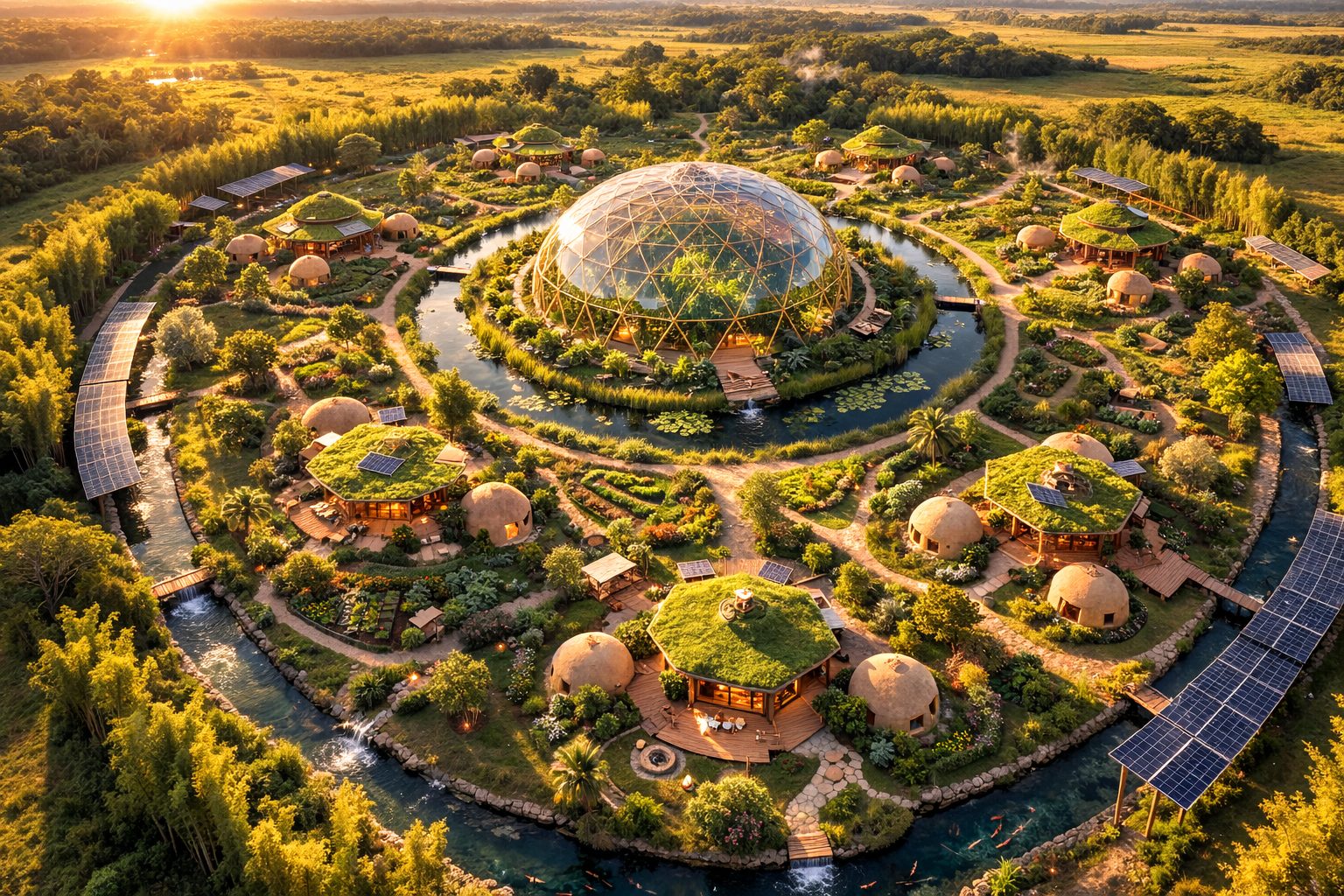
The industrial model treats symptoms while leaving the underlying system intact. Rubania redesigns the institutions underneath daily life: how work is organised, how effort is valued, and how shared decisions become coordinated action.
Rubania treats governance, accounting, and deliberation as real infrastructure, just like water lines or energy systems. C.O.S., Praxion, Criterion, badges, and cycles are meant to make communal life legible enough to stay fair under real pressure.
This is an honest social experiment, not a polished promise. The aim is to test whether a regenerative settlement can be materially viable, socially coherent, and replicable enough for other groups to fork and improve.
Multidimensional action vectors. Every task tagged by Domain, weighted by scarcity, adjusted by quality. Three core dimensions: Cognitio (mental), Sympathia (social-emotional), Labor (physical). Your contribution identity as a 14-dimension map.
Epistemic scoring for deliberation contributions. Badge-gated delegation eligibility, influence decay, anti-gaming validation through anonymous peer review. Short cycles incentivise reaching consensus faster — the best deliberators are those who resolve, not those who prolong.
Delegate your vote per Domain to trusted experts. Your Energy delegate may differ from your Health delegate. Expertise accumulates political influence within competence areas.
Universal namespace organising all activity: Energy, Land, Water, Construction, Produce, Animal Husbandry, Health, Education, Governance, Economy, Culture, Logistics, Constitution, and Architecture.
Percentile-based skill recognition: 🟢 Apprentice (>10th), 🔵 Practitioner (>50th), 🟣 Master (>90th). Gates role eligibility, enables mentorship tracking, and unlocks task tiers across domains.
Three-dimensional sacrifice layer mirroring the action vector: Vocation (opportunity cost), Health (physical well-being), Society (family and social bonds). Bidirectional curves that push you out of your comfort zone — and pull you back when you drift too far.
Accumulated minute-debt triggers mandatory mission assignments — intense, unscheduled volunteer tasks. You can't repay debt with routine actions. Designed to create healthy aversion to falling behind while preserving daily flexibility.
Lunar-phase cycles (new moon / full moon) for contribution accounting. Solstice and equinox super-cycles for community festivals and seasonal rebalancing. Each season has its gathering; each cycle its reckoning.
Self-assigned effort weights are validated by unexpected, anonymous, always-different auditors. Corrections use historical standard deviation — like neural network weight updates — to converge on fair valuation over time.
Before there is a settlement, there is a gathering. The festival is the first encounter — a living prototype where strangers become neighbours, where the ideas leave the page and become experience. Workshops, assemblies, music, shared meals, building together. You arrive curious. You leave committed.
This is the front door to Rubania.

breathing.land →
• Assemblies — First taste of liquid democracy and collective decision-making
• Workshops — Permaculture, bioarchitecture, energy systems, governance games
• Building — Hands-on construction of temporary structures with real techniques
• Community — Shared cooking, music, theatre, meditation, storytelling
• Token launch — First commitment tokens are acquired here
Economic viability isn't reached. The land is sold, capital is returned to participants. Nobody loses money. The documented attempt becomes a public resource for future efforts.
Critical mass of social commitment isn't reached, but the land becomes a productive estate. Participants remain shareholders of an operation that generates rental income. A business, not a home — but not a loss.
The settlement is economically viable and socially cohesive. Residents choose to stay. The new way of life works. Food, energy, governance, fraternity — all functioning. The proof of concept is alive.
The model works so well that replication becomes organic. New groups fork the framework. The tissue grows. What started as one cell becomes a network of regenerative settlements — the original vision realised.
The structured reading page for Rubania's papers, live pages, placeholders, and reference materials. Best if you want the whole site map instead of isolated links.
GovernanceThe civic operating system behind deliberation, contribution, trust, and execution. A practical entry point into how Rubania tries to coordinate communal life without bureaucracy.
EnergyFrom biomass backbone to solar integration, this page sketches the repairable energy stack Rubania imagines for cell-scale autonomy.
SettlementHolonic architecture from compound to guild to cell, with the settlement treated as social technology rather than a loose collection of buildings.
EconomyThe economic layer behind valued effort, accountability, and commitment tokens, with an emphasis on fairness without collapsing life into flat labor hours.
RoadmapThe staged path from cultural formation and site choice to build-out, settlement, and eventual forking of the model into new cells.
ReferenceOverview of the self-management practice for organisations, a key influence on Rubania's governance model.
ReferenceThe ecological design framework underlying Rubania's approach to land use, food production, and closed-loop resource management.
ReferenceThe AQAL meta-framework (All Quadrants, All Levels, All Lines) that informs Rubania's whole-person developmental approach.